- 작성일 2026.02.13
- 작성자 고려대학교 세종캠퍼스
- 조회수 7
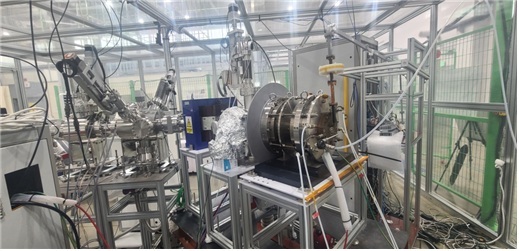
Research Utilizing Diverse Ion Beams, including Protons, Helium, and Oxygen, Enters Full-Scale Operation
Korea University Sejong Campus is operating an in-house developed medium ion accelerator ion source installed at the Accelerator and ICT Building. The facility can generate a wide range of ion beams, including protons, helium, oxygen, argon, and nitrogen, which are being actively utilized in research across multiple fields such as materials science, semiconductors, battery materials, and biotechnology.
The ion source is based on a 14 GHz Electron Cyclotron Resonance (ECR) beam irradiation system and is supported by a comprehensive accelerator infrastructure independently developed by the campus. This includes vacuum and cooling systems, radio frequency systems, beam diagnostics, control systems, and interlock systems.
Professor Kim Eunsan of the Department of Accelerator Science at Korea University Sejong Campus stated, “In addition to advancing ion source research and training specialized personnel, we are actively conducting beam application studies. We are preparing further facility expansion with the goal of providing higher-level ion beams, including the extraction of metallic ion beams.”
Dr. Lee Byeongseop of the Korea Basic Science Institute (KBSI) participated as an instructor in the Korea University accelerator field training program last summer and conducted surface modification research using the ion source facility. He explained, “By implanting nitrogen ions into SiO₂ substrates, we aim to quantitatively analyze experimental conditions and derive physical mechanisms distinct from conventional single-ion implantation through multi-
charge ion implantation.” He further noted that nitrogen ions offer broad application potential, including dielectric nitridation, enhanced plasma resistance, and refractive index control, thereby expanding the scope of related research.
Professor Jeong Byeongho of the Division of Semiconductor Physics at Korea University Sejong Campus stated, “We are utilizing proton beams to induce surface modification effects in silicon semiconductor thin films that are difficult to achieve through conventional photolithography processes and applying these results to research on nanoelectronic and nanophotonic devices.”
Relatedly, Korea University Sejong Campus is also engaged in the development of key accelerator components such as magnetic field measurement systems, radio-frequency devices, and beam diagnostics. In collaboration with overseas research institutes and industry partners, the campus is conducting superconducting accelerator cavity development and beam testing. Through these efforts, the university continues to cultivate accelerator expertise and accumulate core technologies, contributing to the development and operation of large-scale national research facilities such as synchrotron radiation accelerators and heavy-ion accelerators.
Over the past several years, the ion source facility at Korea University Sejong Campus has undergone continuous expansion and upgrades and is now being operated as a fully functional research facility, actively supporting beam-based experimental research.