- 작성일 2026.02.13
- 작성자 고려대학교 세종캠퍼스
- 조회수 6
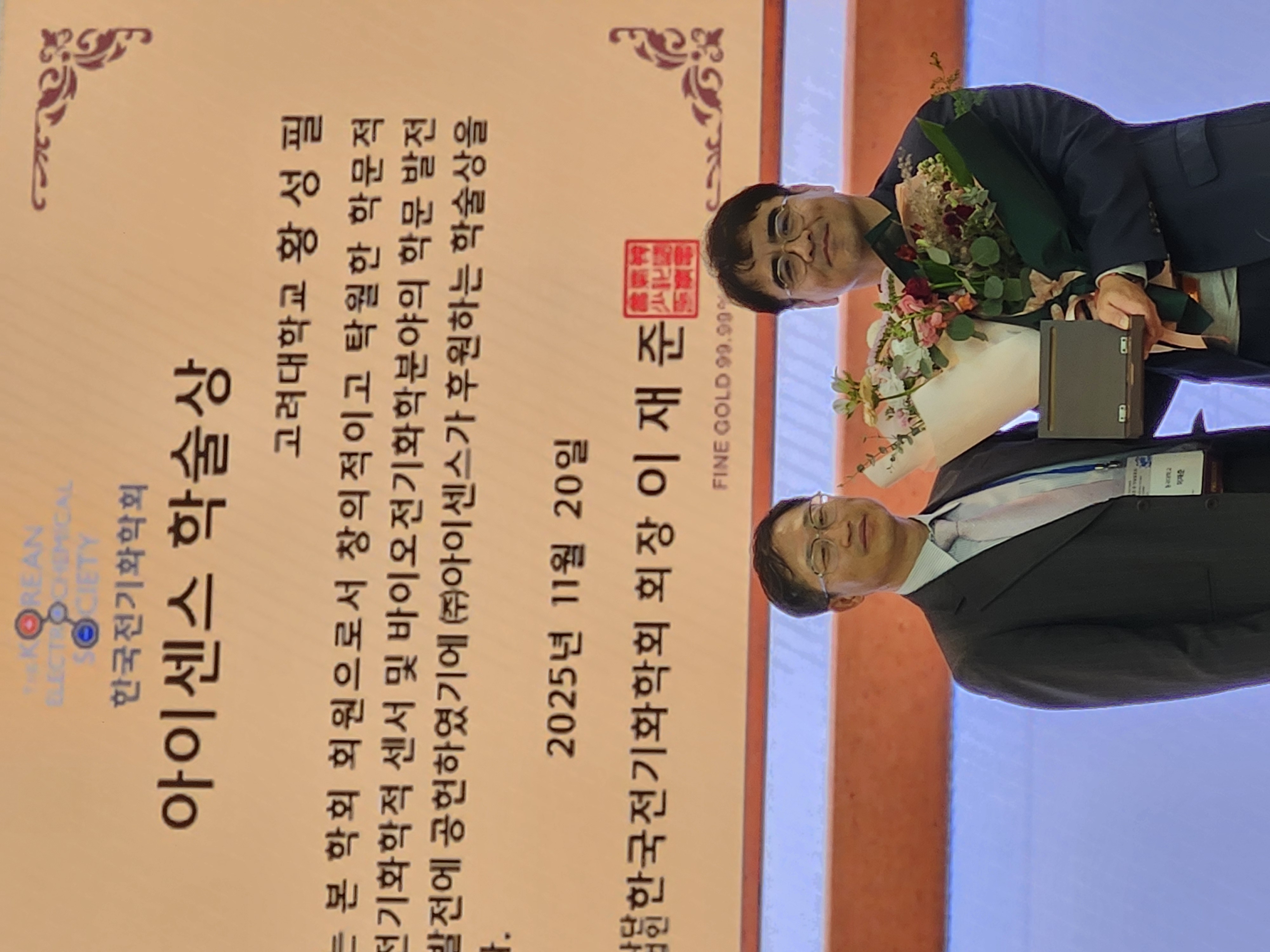
Professor Hwang Sungpil of the Department of Advanced Materials Chemistry Receives the 2025 i-SENS Academic Award
On November 20, Professor Hwang Sungpil of the Department of Advanced Materials Chemistry at Korea University Sejong Campus received the 2025 i-SENS Academic Award at BEXCO in Busan.
The i-SENS Academic Award is an award in the field of electrochemistry given to researchers who have contributed to academic and technological advancement in the fields of electrochemical sensors and bioelectrochemistry, based on funds annually donated by i-SENS Co., Ltd.
The award ceremony was organized under the auspices of the Korean Electrochemical Society, and Professor Hwang Sungpil is scheduled to deliver a commemorative award lecture in the Physical Electrochemistry Division thereafter.
Professor Hwang has been recognized as a pioneer who opened a new research paradigm in nano-electrochemistry by precisely integrating AI-based signal processing technologies with atomic force microscopy (AFM).
Under the research philosophy that “a deep understanding of fundamentals gives rise to the most creative applications,” he received high praise for expanding the horizons of basic science by realizing real-time observation and quantitative analysis of nano-scale electrochemical phenomena, which had previously been regarded as highly challenging.
The research team combined advanced signal analysis algorithms and AI technologies with electrochemical measurement platforms, enabling observations that were difficult to achieve using conventional methods, including kinetic observation at the single nanoparticle level, time-resolved impedance analysis, and high speed voltage and current-based reaction detection. In addition, using atomic force microscopy, the team pursued investigations of core principles based on fundamental scientific challenges such as direct measurement of the point of zero charge (PZC) of single nanomaterials and identification of charging phenomena at complex three phase interfaces.
The outcomes of this basic research naturally expanded into applied studies of future innovative technologies such as electronic skin and energy harvesting, presenting a virtuous cycle model linking fundamental research and applications.
The Korean Electrochemical Society evaluated the work by stating that “Professor Hwang’s research is a leading achievement that has presented new possibilities in the field of nano-electrochemistry,” and that it is “an exemplary case demonstrating that the power of basic science forms the foundation for the development of advanced technologies.”