- 작성일 2026.02.13
- 작성자 고려대학교 세종캠퍼스
- 조회수 6
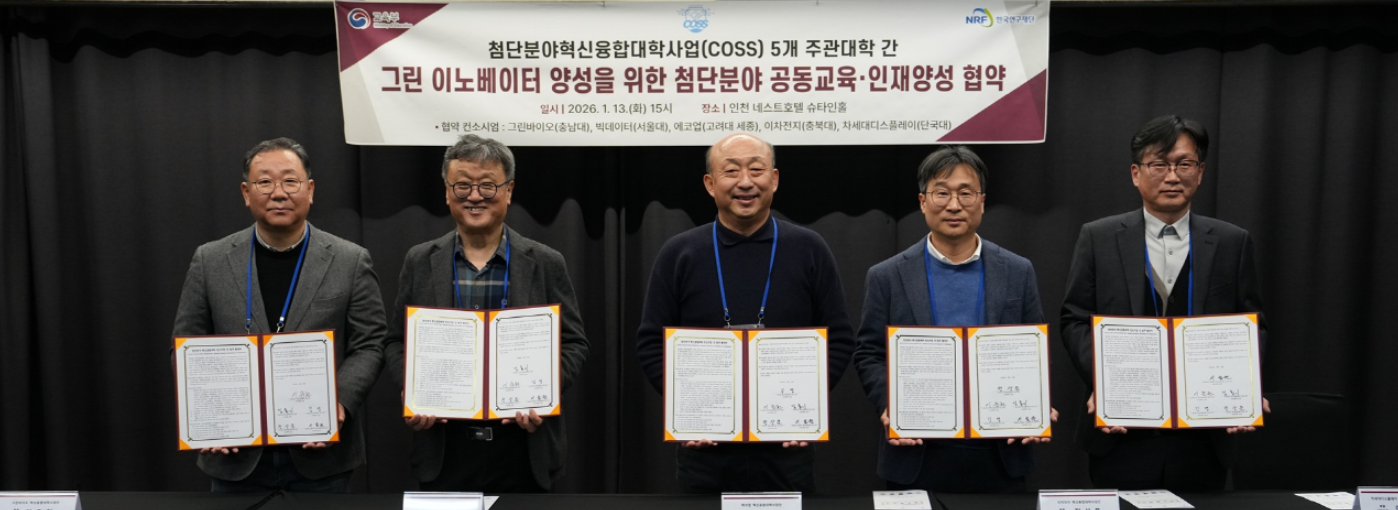
Four advanced industries in the Chungcheong region form a ‘GDX Alliance’ with Seoul National University’s big data consortium
Director Kim Young: “The only weapon to overcome environmental regulations is data… convergence human resource is corporate competitiveness”
The Eco-Up Innovation Convergence University Project Group (Convergence and Open Sharing System, COSS), led by Korea University Sejong Campus, has established a mega-regional human resource development alliance that combines the core industries of the Chungcheong region with the data analytics capabilities of Seoul National University.
On the 13th, at the ‘COSS Performance Forum’ held in Songdo, Incheon, the project group signed an ‘Advanced Field Joint Education and Human Resource Development Agreement (AIPP Pact)’ with four Chungcheong-based consortia: Eco-Up, Green Bio, Secondary Batteries, and Next-Generation Display, together with the Seoul National University Big Data Consortium.
The most notable feature of this agreement lies in connecting different advanced industrial fields through the shared medium of the contemporary values of ESG (Environmental, Social, and Governance) and the technological driving force of big data.
As global environmental regulations such as the EU’s Carbon Border Adjustment Mechanism (CBAM) continue to strengthen, demand is rapidly increasing in advanced manufacturing sites for talent capable of precisely measuring and managing carbon emissions through data-based green technologies, referred to as Green Digital Transformation (GDX).
Accordingly, the five participating consortia formed the ‘AIPP (Advanced Innovation Partnership for Professionals).’ Under this framework, universities in the Chungcheong region will provide manufacturing process data and field based training opportunities, while the Seoul National University Big Data Consortium will share AI- and data-driven curricula for analysis and optimization. Through this cooperation, participating students are expected to grow into ‘Green Innovators’ capable of simultaneously handling production technologies and environmental data in advanced industries such as semiconductors and batteries.
Kim Young, General Director of the Eco-Up Innovation Convergence University Project Group at Korea University Sejong Campus, who led the agreement, stated, “The era of learning environmental studies and engineering separately is over. The core of this AIPP Pact is to cultivate convergence talent that will take responsibility for the eco-friendly competitiveness of Korea’s advanced industries by combining the manufacturing sites of the Chungcheong region with Seoul National University’s big data capabilities.”
Relatedly, the Advanced Field and Convergence Open Sharing System (COSS), promoted by the Ministry of Education and the National Research Foundation of Korea, aims to foster 100,000 core talents across 18 advanced strategic fields that will lead national strategic industries through inter-university and inter-industry collaboration.
[Status of the five participating consortia]
1. Eco-Up Consortium: Korea University (Sejong), Korea University (Seoul), Konkuk University, Yeungnam University, Vision College of Jeonju
2. Green Bio Consortium: Chungnam National University, Seoul National University, Kyung Hee University, Chonnam National University, Yeonam College
3. Big Data Consortium: Seoul National University, Gyeongsang National University, University of Seoul, Sookmyung Women’s University, Jeonbuk National University, Handong Global University, Gyeonggi University of Science and Technology
4. Secondary Battery Consortium: Chungbuk National University, Pusan National University, Gachon University, Inha University, Gyeongnam College of Information & Technology
5. Next-Generation Display Consortium: Dankook University, Kyung Hee University, Hoseo University, Hanseo University, Chungbuk Health & Science University